

I don't like Leeds. It's a prejudice formed in part from the Leeds-centric bias of regional news magazines, in part from the city's dingy train station (the first at which I encountered the evil that is ticketed entry and exit), and in part from an ill-prepared visit there that failed to locate any decent pubs. But mainly it stems from one cold, wintry night when I had to walk the streets of Leeds till dawn's first trains, and in the process (thanks to recent flooding) managed to tread on a fish.
But Library Camp Leeds was not a city-centre affair. Library Camp Leeds was in lovely, leafy Horsforth: a land uncontaminated by my fishy prejudice. In Horsforth the sun shines brightly on visiting librarians.
It was with some nervousness that, in the weeks ahead of the event, I noticed a clash in my diary. For Saturday 26th May also held a sacred and annually observed holiday: The Eurovision Song Contest. Fortunately, public transport would allow me to get home in time for the hallowed event and still have opportunity for a post-Camp drink.
In tribute to whatever higher powers permitted this glorious conjunction, I decided to bake for Horsforth my first Library Camp offering, settling on a Honey Flapjack adapted from this BBC recipe. I'm glad to say that it went down well (although perhaps not as well as @daceudre's cheese sticks).
With the sun now promenading in full 'thermal death ray' mode after several months in hiding, I had to make a last minute change to my intended wardrobe in a desperate attempt not to melt. This sudden warmth in the world brought out on show a splendid array of sartorial summeriness (high on my want list was @bumsonseats' rosy number), and we all looked rather wonderful in this rare sunshine spotlight.
But we're not here to talk about cooking and clothes... well not just about cooking and clothes... there's these funny things called libraries to discuss. As ever, my descriptions below use the sessions as starting points for a few thoughts of my own, but, where available, I've linked to other accounts of the day.
Session 1: eBooks

Session 1: eBooks
@pennyb led this session, and you can read her account of it at LISNPN. I started writing a post on this subject a few months ago but it's such a knotty, frustrating and fast-moving area that I never finished the article and it's now looking somewhat out of date as it languishes in my drafts pile. Nonetheless, the ebook question is probably one of the most important issues there is in libraries at the moment, and the ©-shaped knots involved go right to the core of what libraries are. At some point in the future, when all monitors use coloured e-ink and when wi-fi is available to us all wherever we may be, the ebook question will be somewhat easier and more straight-forward to negotiate, but that future is a fair way off and in the meantime we have to deal with a mess. We currently inhabit a world where Kindle has become the Hoover of e-readers, and the end of the Amazon-Waterstones war will make this state of affairs all the more true. I think we can thank lazy journalism for this Kindle hegemony: certainly, in a Which?-style comparison, the Kindle's limited support of file-types makes it look as enticing as a hi-fi that consists only of a radio, when I've got a stack of CDs, tapes and records I want to play. This lack of support extends to library ebooks, and one can imagine the frustration of the newly Kindled library member turning up to borrow an ebook and being told they've bought a dud. But the frustrations are not limited to Kindle-owners. Even a library member savvy enough to have bought an e-reader that can read the file-types their library offers will be faced with an array of irritating limitations imposed by the terrified publishers-that-be. The situation is farcical and far from user-friendly, although that is part of the point: publishers very much want the path of least resistance to be the one which makes them the most money, and at the moment it's the publishers laying the terms. It's hard to see this mess being overcome without some collective endeavour on the part of libraries, and ideally with the help of forward-thinking government legislation (a fantasy in the current political wilderness).
Underlying all of this is the Big Question: the internet-created challenge to the economic model that has sustained the creative arts since the advent of mass-media. How do we fund the arts?
When libraries started out, professional authors did not really exist. Even today they constitute a small minority of writers, with PLR offering token recompense to the rest. With a fixed print-run, a publisher's concern is that all the books are sold, and in some cases a library in every town may benefit those sales. The lending of books was no great threat, plus it educated the masses and increased the market for future works, creating a world where books can now fill a whole aisle of Tescos. eBooks are more troublesome: there's no PLR, and the ephemeral nature of the medium in the eyes of the market makes for a retail mark-up with minimal margins. When anybody can stick a pdf on the internet, the role of the publisher is reduced to finance, quality control and distribution (something which the library itself could conceivably facilitate). The loss of the physical book (and its appeal as an owned artefact) means that a bought ebook is practically no different to a loaned ebook: the two are potentially as accessible, and both are in identical condition. If libraries are able to loan ebooks there becomes no reason to ever buy an ebook. It is for this reason that publishers are seeking to make the process of ebook lending such a faff: to make it far easier to buy than to borrow.
Perhaps the solution is to address this equivalence problem in a different way. Not all publishers are so troublesome to libraries, and in the realm of magazines there are some genuinely good deals to be had (Zinio, for example). Why should magazine publishers be so much more friendly to us? Because their funding model is built largely upon advertising, and the more people who see those adverts, the higher the advertising fees can be. Perhaps, then, a future model for ebook loans would see library ebooks subsidized through advertising, much like the free version of Spotify.
@llordllama asked this question, primarily with respect to how we present our teaching sessions. The answer was a resounding "Yes" (such were the acoustics). There then followed a few anecdotes regarding how best to thaw an icy audience. I must confess that I have in my time been one of the stonier students: when faced with a Tiggerish presentation I tend to assume the Eeyore position. Such are the complexities of humour (as demonstrated by the success of Michael McIntyre): one person's joke is another's cringe. In that respect it's important to not lose sight of the aim of a teaching session: to impart knowledge. The way in which we go about imparting that knowledge relies very much upon ourselves. Michael McIntyre might make me despair for humanity, but I am none-the-less aware that he has something called a "Man Drawer" where he keeps the sort of things late night 'phone-in competition organizers store in their handbags. This knowledge has reached me irrespective of my enjoyment of the delivery, and while I may not have been amused, it was evident that several others were, himself included. This latter point may be the crux of the matter: a significant part of why I use humour in my teaching is as a crutch for myself: as a bolster against my shyness and insecurities; any thawing or engaging effect is a bit of a bonus really.
It being such a lovely day, we decided to head out into Horsforth Hall Park in the afternoon, to bask in the dappled shade of trees and to fend off the interests of passing hounds. There, in a gentle rain of blossom, @preater led a discussion about 'next-generation library catalogues' and whether their efforts to integrate aspects of social media are successful. You can read his account of the session at his "Ginformation Systems" blog.
Catalogue search strategies are a big interest of mine (they were the subject of my dissertation), and I analysed the retrieval characteristics of a range of catalogues as part of an information retrieval project at library school (I should really update the results and write a post on the subject). This latter exercise was sufficient to instil within me a great disaffection for the modern, Google-influenced trend of having a single search box at the front of a catalogue. Such an approach would be fine, were the results to be derived from the full texts of all the items available to the library. Alas we are not quite there yet, and a keyword search of a catalogue record can throw up some pretty wild results. A keyword search of "George Orwell" for instance, is unlikely to find a work by the chap until about a page into the results, because the metadata in a biography or critique of Orwell will tend to throw up more hits for his name.
This is a superficial problem which can be overcome through search refinement forms or advanced search options, but such moves take time. The thing that made Google such a success was not the simplicity of its design so much as the speed at which it returned its (relevant) results. A significant further problem with many of the next-gen catalogues I've encountered is that they are bandwidth and memory hungry, splattered as they are with flashy scripts and third-party content, and that all this has the unfortunate tendency to make using such catalogues a slow and laborious process. This process is made all the more sluggish when the catalogue is being used on a dedicated terminal, which may well be an old computer and one which gets little exercise.
The new generation of catalogues do have some useful tricks up their sleeves, though, perhaps the most beneficial being their error correction and "Did you mean...?" suggestions. Amazon-inspired features such as reviews, related reading details and user-generated tagging are of more questionable benefit, and seem not to be particularly well used. Perhaps our members have better things to do than to write content for our catalogue. Third-party reviews drawn from a broader pool may stimulate interest, however, and there's a wealth of material hiding in our LMS that might be utilised to illustrate the value or popularity of a title. The catalogue in use where I work displays the last return-date of an item, and this in itself may serve as a basic indicator of currency. One might expand this into a full date sheet for the book; it might even be formatted using a bespoke date-stamp font for added nostalgia! Our dataset is our oyster in such things, at a time when information is considered beautiful. The only drawback is that we might further fuel demand for our most popular hotcakes, rodding our own backs in the process.
Session 4: Space

@bumsonseats kicked us off on this final session, a continuation of a theme encountered at the Manchester Library Camp in January. Her summary can be found on her "Growing a library" blog. As I considered a couple of posts ago, we have to be careful with what we do to our library spaces, because we haven't got so many and we've got to use them to their maximum potential without damaging them for our core membership. It's not an easy task to negotiate, especially in the realm of public libraries, where resources are tight and spaces old and scarce. One might weed out the old and tatty stock in an effort to look clean and welcoming only to find that there's no longer much stock at all and the place looks sterile and empty. Any revision of space needs to be properly thought through, well researched and well designed, but that sort of thing takes money and that's the one thing we haven't got right now. Consequently we have to muddle through and compromise as best we can. The list of points in @bumsonseats' blog post gives an idea as to the sort of stuff we should be considering in such circumstances.
Sessions over, we went off to the pub, where I had just enough time to squeeze in a couple of glasses of Pimms before I had to get my train. I only wish I could've stayed longer and spent more time with everybody there, but alas, Charpentier was calling...
Underlying all of this is the Big Question: the internet-created challenge to the economic model that has sustained the creative arts since the advent of mass-media. How do we fund the arts?
When libraries started out, professional authors did not really exist. Even today they constitute a small minority of writers, with PLR offering token recompense to the rest. With a fixed print-run, a publisher's concern is that all the books are sold, and in some cases a library in every town may benefit those sales. The lending of books was no great threat, plus it educated the masses and increased the market for future works, creating a world where books can now fill a whole aisle of Tescos. eBooks are more troublesome: there's no PLR, and the ephemeral nature of the medium in the eyes of the market makes for a retail mark-up with minimal margins. When anybody can stick a pdf on the internet, the role of the publisher is reduced to finance, quality control and distribution (something which the library itself could conceivably facilitate). The loss of the physical book (and its appeal as an owned artefact) means that a bought ebook is practically no different to a loaned ebook: the two are potentially as accessible, and both are in identical condition. If libraries are able to loan ebooks there becomes no reason to ever buy an ebook. It is for this reason that publishers are seeking to make the process of ebook lending such a faff: to make it far easier to buy than to borrow.
Perhaps the solution is to address this equivalence problem in a different way. Not all publishers are so troublesome to libraries, and in the realm of magazines there are some genuinely good deals to be had (Zinio, for example). Why should magazine publishers be so much more friendly to us? Because their funding model is built largely upon advertising, and the more people who see those adverts, the higher the advertising fees can be. Perhaps, then, a future model for ebook loans would see library ebooks subsidized through advertising, much like the free version of Spotify.
Session 2: Can we be funny?
Session 3: The anti-social catalogue
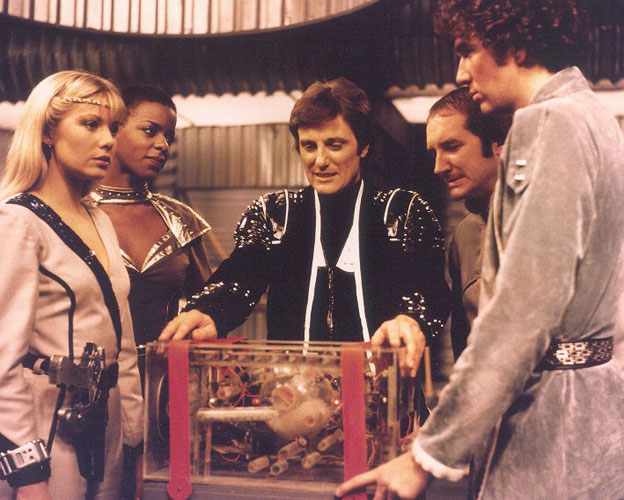
The crew of the Liberator take delivery of their shiny new OPAC.
Catalogue search strategies are a big interest of mine (they were the subject of my dissertation), and I analysed the retrieval characteristics of a range of catalogues as part of an information retrieval project at library school (I should really update the results and write a post on the subject). This latter exercise was sufficient to instil within me a great disaffection for the modern, Google-influenced trend of having a single search box at the front of a catalogue. Such an approach would be fine, were the results to be derived from the full texts of all the items available to the library. Alas we are not quite there yet, and a keyword search of a catalogue record can throw up some pretty wild results. A keyword search of "George Orwell" for instance, is unlikely to find a work by the chap until about a page into the results, because the metadata in a biography or critique of Orwell will tend to throw up more hits for his name.
This is a superficial problem which can be overcome through search refinement forms or advanced search options, but such moves take time. The thing that made Google such a success was not the simplicity of its design so much as the speed at which it returned its (relevant) results. A significant further problem with many of the next-gen catalogues I've encountered is that they are bandwidth and memory hungry, splattered as they are with flashy scripts and third-party content, and that all this has the unfortunate tendency to make using such catalogues a slow and laborious process. This process is made all the more sluggish when the catalogue is being used on a dedicated terminal, which may well be an old computer and one which gets little exercise.
The new generation of catalogues do have some useful tricks up their sleeves, though, perhaps the most beneficial being their error correction and "Did you mean...?" suggestions. Amazon-inspired features such as reviews, related reading details and user-generated tagging are of more questionable benefit, and seem not to be particularly well used. Perhaps our members have better things to do than to write content for our catalogue. Third-party reviews drawn from a broader pool may stimulate interest, however, and there's a wealth of material hiding in our LMS that might be utilised to illustrate the value or popularity of a title. The catalogue in use where I work displays the last return-date of an item, and this in itself may serve as a basic indicator of currency. One might expand this into a full date sheet for the book; it might even be formatted using a bespoke date-stamp font for added nostalgia! Our dataset is our oyster in such things, at a time when information is considered beautiful. The only drawback is that we might further fuel demand for our most popular hotcakes, rodding our own backs in the process.
Session 4: Space
Sessions over, we went off to the pub, where I had just enough time to squeeze in a couple of glasses of Pimms before I had to get my train. I only wish I could've stayed longer and spent more time with everybody there, but alas, Charpentier was calling...
Thirty years ago, the contest was surprisingly close.

No comments:
Post a Comment