Tuesday, 16 August 2011

Saint Evelin in Room 237 with the Dissertation.

All work and no play makes Evelin a dull Saint. All work and no play makes Evelin a dull Saint. All work and no play makes Evelin a dull Saint. All work and no play makes Evelin a dull Saint. All work and no play makes Evelin a dull Saint. All work and no play makes Evelin dull Saint. All work and no play makes Evelin a dul Saint. All work and no play makes Evelin a dull Saint. All work and no play makes Evelin a dull Saint. All work and no play makes Evelin a dulll Saint. All work and no play maes Evelin a dull Saint.    

All work and no play makes Evelin duull Saint. All work and no play makes Evelin a dull Saint. All work and no play makes Evelin a dull Saint. All owrk and no play makes Evelin a dull Saint. All work and no play makes Evelin a dul Saint. All worki and no paly makes Evelin adull Saint. All work and no play makes Evelin a dull Saint. All work and no play makes Evelin dull Saint.    

All work and no play makes Evelin a dull Saint. Alll work and no play makes Evelin a dull Saint. All work and no play makes Evelin a dull Saint. All work and no play makes Evelin a dull Saint. All work and no play makes Evelin a dull Saint. All work and no play makes Evelin a ull Saint. All work and no play makes Evelin a dull Saint. All work and no play makes Evelin a dull Saint.   

All work and no play makes Evelin dull Saint. All work and no play makes Evelin a dull Saint. All work and no play makes Evelin a dulll Saint. All work and no play makes Evelin a duull Saint. All work and no play makes Evelin a dull Saint. All work and no play makes Evelin a dull Saint. All work and mo play makes Evelin a dull Sint. All work and no play makes Evelin a dul Saint. All work and no play maes Evelin a dull Saint.    All work and no play makes Evelin a dull Saint. All work and no play makes Evelin a dull Saint. All work and no play makes Evelin a dull Saint. All work and no play makes Evelin a dull Saint. All work and no play makes Evelin dull Saint. All work and no play makes Evelin a dull Saint. All work and no play makes Evelin a dull Saint.  

All work and no play majkes Evelin a dull Saint. All work and no play makes Evelin a dull Saint. All work and no play makes Evelin a dull saint. All work and no play makes Evelin a dull Saint. All work and no play make Evelin a dull Saint. All work nd no play makes Evelin a dull saint. All work and no play makes Evelin a dull Saintl All work and no play makes Evelin a dull Saint. 

All work and no play makes Evelin a dull Saint.

Saturday, 6 August 2011

CPD23:9 Never Forget Where You're Coming From

Evernote is a... um... well, it's for... it... um... Ok, I give up. I've been looking at this thing for the best part of a fortnight and I'm still none the wiser. I've been sitting here waiting for the rest of the CPD23 community to give me some ideas, but you're all being very quiet or very gnomic on the matter. Hmm...

Here's what the CPD23 post on Evernote has to say for itself:
"The problem: You want to be able to make comments on webpages and archive them along with your own notes so that everything is all in the one place and easy to access. The problem-solvers: Evernote allows you to take notes on webpages and archive them for later consultation. Your notes can have file attachments and be sorted into folders, tagged, annotated etc."

Let's take that bit by bit. "You want to be able to make comments on webpages and archive them along with your own notes so that everything is all in the one place and easy to access." Fair enough. Yup, I might want to do that. I might see a webpage and make a few notes on it. Tis true. So I open an email, or my browser's notepad, or my sidebar notepad, or Windows notepad, and I copy the URL and I make my note. Or, if I'm concerned that the page will be different tomorrow, I save a copy of the page, or take a screengrab, and stick that as an attachment to the email, or as a link in the notepad. Things could scarcely be simpler. Evernote seems to be a way of doing this, only in a more complicated manner. With Evernote, "Your notes can have file attachments and be sorted into folders, tagged, annotated etc." So just like you can in an email, or with files in Windows if you were sufficiently organized. I'm struggling to see the point.

"Evernote is not just for making notes but can be used for archiving pictures from your computer or webpages or photographs taken during conferences to save you having to take notes all the time. All you have to do is to click New Note again and click and drag a photograph from the web or your computer etc. and drop it into your new note (or you can copy and paste if you prefer)." A bit like when I click 'Compose' in my email client?  I'm still missing something.

"Evernote for Windows or Mac will automatically synchronize your notes with Evernote on the Web every few minutes... (This means that changes you make to your Evernote account on different appliances i.e. computers, phones or mobile devices will all synchronise to keep your account up to date)." Ok, so there's webspace involved (just like if I were to use a web-client for my email). I'm beginning to see the faintest sliver of a function.

"You can also save web content, which involves installing the Web Clipper (a quick and easy process which adds the Evernote button to your Internet browser). All you need to do it to highlight the information you want to save and click on the Evernote button." This function is unsupported by my browser of choice, but seems to be little more than a copy/paste shortcut.

From the Evernote website, we learn "Evernote magically makes printed and handwritten text inside your images searchable, too." It does, and it does it quite effectively: better than the OCR program I have on my computer. But it does it at a rather leisurely pace unless you pay them money. I put three pictures in last week, and only one has been translated. So maybe in a month the function will be of use, but as it is I could copy out the information quicker.

It is the searchability, and this OCR function, that really makes Evernote worthy of even the slightest attention. But my browser notepad and my home email client are eminently searchable (though Outlook and Windows are admittedly less so (to the point of declaring war)). The webspace aspect is clearly of use, but there are plenty of bits of free webspace knocking about the internet without having to download a client. I dare say there are also considerably speedier and perhaps equally effective OCR systems available too.

So I remain very unconvinced about the need to have yet another process cluttering my taskbar and wasting valuable memory. It seems to me that Evernote is something of a white elephant.

CPD23:8 (Local Edition) Google versus Christa

In these parts the passage of time is measured on only one calendar:


For me a calendar is not a calendar without Austin Mitchell, Richard Whiteley, Christa Ackroyd or Christine Talbot somewhere in the mix. But we can't carry Kirkstall Road's finest with us everywhere (though I do keep Gaynor Barnes in a backpack). To negotiate ones hectic schedule on the move, one needs some sort of portable diary to keep track of forthcoming events.

I've never been very good with diaries. I have a cupboard full just here, most of which seldom have anything written in them beyond January. Generally I have been rather better at remembering dates than writing them.

Now, though, alcohol and age weary my brain. When I started Library School it became apparent to me that some sort of grand timetable might be of use. And so I made myself a little calendar and kept it in my notebook. This was all well and good if I had my notebook with me: ideal for when I had a lecture, but less so at any other time. So I had another little notebook too, and various bits of paper, and everything would (sometimes) be collated into a grand spreadsheet here on my computer (you may recall it as #50 in this post).

This situation was unsatisfactory. I considered some web-based solution but realised I would never keep it up to date. What would be useful, though, I thought, would be an on-line lecture timetable of some kind. It just so happened that my university was thinking along a similar path, and had attempted to cobble together a Google Calendar. I played around with it, and eventually copied some script to a webpage where I could refer to the calendar with ease. Alas, most of the time only half my lectures would appear. Doubtless the problems were more the fault of the university than of Google Calendar, but the whole débâcle did nothing to win me over to the concept. I considered another faff around but decided it would be quicker to write the thing out on a piece of paper.

This far from ideal state of affairs lasted until just the other month, when I bought myself a new telephone (of the mobile variety) complete with a built-in calendar. My telephone travels with me pretty-much everywhere and so now when I have an event I wish to record, I can record it to that. My diary woes are solved.

At work, itinerant members of staff are encouraged to share their hectic lifestyles in the calendar bolted to Microsoft's Outlook email client. Outside work I am loathe to broadcast to a wider audience my precise location for fear that they might find me. In both regards, Google Calendar seems redundant.

On the subject of Google more generally, it's been annoying me an awful lot of late. As a consequence of this blog I have acquired "an account" which serves, essentially, to make searching the web more difficult, and checking my university email account even more of a chore than it was before. In this climate, my interest in a Google Calendar is somewhat less than my interest in the local news programming of an area other than the one in which I live (for at least that has some curiosity value).

In the '90s, my friends and I became mildly obsessed with Calendar, mainly because it was a bit crap. Our obsession was rewarded consistently: a behind-the-scenes documentary (Channel 4's Deadline), a late-night version of the show set in Emmerdale Farm's Woolpack (with Mike from Mike's Carpets behind the bar), a Calendar-based panel-show presented by Barry Cryer (Cryer's Crackers) with Richard and Christa as team captains, and real-life Alan Partridge-esque car-crash The Richard Whiteley Show. Until Google's knock-off version of Calendar comes complete with such extras as this, I will have nothing to do with it.

I was going to end this CPD23 post with a clip of Cryer's Crackers or The Richard Whiteley Show, but, alas, YouTube has scant footage of both (a Google conspiracy, no doubt). Instead, revel in the greatest gift that Calendar did bring:


Stop and reset. 

Tuesday, 2 August 2011

LibDay7: Drink, Dreams & Dissertation

By day, tis said, I work in a library. But not in the summer months. In the summer months I am stood down to enjoy a life of leisure. Here in the northern hemisphere those summer months are happening right now. I am at home rather than in the library. But where's the leisure I was promised? It has been replaced by the pressures of a dissertation.

This, then, is where Round Seven of the Library Day in the Life Project finds me. Over the course of last week I kept a diary of my antics. Here's each day reduced to a 24hr clock:


Pink represents entertainments, orange is the mundane day-to-day, yellow is concentrated on-line activity, grey is sleep, and green... green is me in a spreadsheet with the dissertation data.

Over the course of the week, then, I spent the equivalent of a little over three days sleeping. Twelve hours were spent down the pub (including a lovely beer festival on Sunday and a meet-up with old Library School friends on Wednesday), ten hours were spent primarily engaging with music, radio or television, nine hours were spent pottering about on-line  (including signing up for Library Camp and booking a post-dissertation holiday), and five hours were spent eating. Three hours were spent getting up, and another three were given over to reading for pleasure. Two and a half hours were spent travelling.

Two whole days were spent working on my dissertation. TWO! More if you count Thursday, when I spent the night dreaming about manipulating spreadsheets. Brr...

Thursday was the day I spent most time on my dissertating. Sunday, comparatively, was a day of rest.

What have I been doing in this dissertation spreadsheet? I have been:
1) Marking up search-engine queries with respect to their content and structure, in order to gauge reformulation patterns.
2) Creating a number of tables and graphs from this data.

Both phases of activity vary in duration depending on a) the complexity of the searches, and b) the number of distractions. This week I have been accompanying my markings-up with a soundtrack consisting of Test Match Special, Five Live Drive, old John Peel tapes, and opera.

In all I have marked up about 10,000 search queries (about two thirds of them in this last week). I can now start to write about them. That's what I'll be doing for the next month. Hopefully I'll find time to squeeze in a few blog posts along the way.

Sunday, 31 July 2011

Seven Books That Changed The Way I See The World

Inspired by Bobbi L. Newman's blog post on the topic, I've tried to come up with the seven books that changed the way I see the world. It's not an easy task, and doubtless I've missed some. It is a list I've cobbled together, hastily, in the last three quarters of an hour, and it is a list which is presented in experiential order:

The House at Pooh Corner - A.A.Milne (1928)
In my mind the better of the two Winnie-the-Pooh books, I first experienced it from my mother's knee at a very early age. It doubtless helped foster my personality and shape my sense of humour. It's a brilliantly written and very funny book, and the end makes me cry.

The Thousand Eyes of Night - Robert E. Swindells (1985)
Swindells was my favourite author as a child, and this was the first of his I read. It came from the local public library. It is the story of a few kids who speculate that unusual mice might have been responsible for some local eviscerations. Contrary to the rules applied in most children's stories I'd read by this point, death poses a very real threat to our protagonists. This detail, as much as anything, made Swindells a gripping author. When I took this book back to the library, I immediately got out The Ghost Messengers, after which there were few other authors who could grab my interest. Swindells' works shaped my concept of adult interaction and perhaps helped make me a secretive sort, enthralled more by my fantasies and woodland adventures than by the drudgery of reality. Swindells had me looking for ghosts at school and making maps of non-existent secret tunnels. In my teenage years I took Lucy Topham, protagonist of A Serpent's Tooth, as something of a role model (though chose to ignore her more drippy character traits). 

The Witches - Roald Dahl (1983)
First experienced in the book-corner at school, circa 1987, read to us by my favourite teacher (and Dahl fanatic), Mrs Morris. The same life-changing concepts in Swindells are to be found here, albeit with a cheeky and dark sense of humour running throughout. Like many children of my age, The Witches stands as Dahl's master-work; the way it ends, in particular, is brilliantly perception-tweaking and is for me the best point of the whole book (another book that excited within me an interest in dark themes and surprise endings is Ruth Brown's A Dark Dark Tale). Dahl influenced me in other ways, too: I nearly killed my grandma with a cup of 'tea' painstakingly brewed from various household liquids and powders.

1066 And All That - W.C. Sellar and R.J. Yeatman (1930)
I read this on a caravan holiday. The pages were falling out and covering me in crusty yellow glue, but in spite of the poor binding I could tell that this book was a Good Thing. It demonstrated to my young self that comedy could be applied to scholarly subjects, and that everything in life can be seen in humourous terms (even death by lamprey). More recently my concept of history is shaped by the Oxford History of England (another influential work which I'm squeezing in here). Its volumes remind one (as is often the case with history) that there are few new things under the sun and that societies of the past were not so far removed from societies of the present. 

Animal Farm - George Orwell (1945)
Following on rather neatly, then, is this allegory of crushed political dreams which I read in bed one teenage evening. Orwell is in good part responsible for my cynicism, I suspect. On the subject of fables, I should also make mention of Watership Down: a tale of death, sex, war, and bunnies. If Watership Down were a sci-fi, it would have an oily-legged slave-woman on the front and would tell the tale of greasy refugees from a dead planet who infiltrate another world to steal its women-folk. It isn't that. It's an allegory of that with rabbits. I think this realization got me to think a bit more about subtexts in literature.

The Pub & The People - Mass Observation (1943)
Picked out at random from the J.B.Morrell library in my last year at York, this was my introduction to Mass Observation and social anthropology. I found its anal documenting of the commonplace to be really rather fascinating: a brilliant and valuable piece of history. It taught me the value of simply looking at the world.

The Female Eunuch - Germaine Greer (1970)
Read on holiday in Northumberland this book probably changed the way I see the world more than any other I've read since the most formative years of my childhood. It unpicked my understanding and stitched it back together again, adding a cherry of pipe-dream utopianism on top as something to which I might aspire. Its blend of socialism and feminism bore deep down through the psychological strata laid in my head by the aforementioned books, and stirred from her slumber the Greenham-tinged Lucy Topham template of my teens, recasting her in a more informed and more self-confident image. I felt my view of the world tested and teased, and while some of what Greer writes is questionable, it still got me thinking about gender and society, and my relationship to both, in a way I hadn't before. 

So that's the seven. I bet I've left something really important out, but it's getting late and I've dissertating to do.

Friday, 22 July 2011

CPD23:6,7 Showing Some Leg

I watched the 1940s melodrama Madonna of the Seven Moons today. It's on iPlayer 'til next Friday should you fancy it too (it's also on YouTube). At the start of the following clip, Maddalena and Giuseppe Labardi await the return from boarding school of their daughter Angela and her new friend, Evelyn:


NOTE: Highlight the spoilers to read:

Maddalena is a straight-laced and devoutly religious society woman, and the anxiety her liberated daughter causes her soon proves too much, ultimately contributing to a mental and physical breakdown. She awakes from this breakdown as a different person : Rosanna : an atheistic gangster's moll and very much the opposite of everything Maddalena represents. It transpires that Maddalena has been subject to previous long-term disappearances during which she has established a parallel life for herself among the Florentine criminal classes. Things come to an operatic head during Carnevale. It's a film of dualities, masks and mistaken identity; from the early reveal of the assumed-to-be-female Evelyn to the climactic fatal mistaking of a rapist for his similarly-clad brother, the whole film dabbles with ideas of society, image and self-representation. The central narrative premise may be a touch shaky, but the thematic elements of the film spoke to me a great deal.

Like Maddalena, I present different faces to different audiences. The way I behave with my parents is different to the way I behave with my work colleagues, which in turn is different to the way I behave with my close friends. This is not an unusual state of affairs, though Google+ appears to be the first social networking tool to really get to grips with it. Pretty much everyone who has an opinion on the matter seems in agreement that the best thing about Google+ is the circles feature that allows one to restrict ones comments to particular groups of people. I do this on a wider level already (as, perhaps, do you). Consider the following approximation of my social groupings (where red represents my closest friends):


For myself, as for many of my peers, Facebook is a place where old school-friends display baby scans. I almost solely use it for its (clunky but effective) message client. Meanwhile, my work colleagues are largely unrepresented in my on-line relationships. The Twitter circle incorporates two near-discrete accounts (yet another way in which I temper my personality with respect to my audience). There are other net-based networks that I have not included in my diagram: forums, for instance. In general, though, I am a 'lurker' in these environments rather than an active participant. Not since the early days of Wikipedia have I taken a reasonably active role in such an on-line community.

One social network I have not joined is LinkedIn, which for a couple of years I assumed was the name of a naff teen-rock combo. Reading Samantha Halford's experiences (Twinset & Purls) generally confirmed my prejudices that this is not a site for me: I like my privacy, and certainly don't want to go waving my CV and my physical identity in the face of anybody who happens to be passing. The place stinks of the Masonic Lodge, but without the perks of copious drinking, tongue-in-cheek ceremony and ribald bonhomie that I suspect accompany the real-life orders. It's far too dry and 'business'-like; not real business so much as that parody of business peddled by Alan Sugar and his Filofax followers. I exaggerate for effect, but the formal tone and market-floor pitch does nothing to convince me that putting my employment history, identity and location on a particularly exposed bit of the internet is a sensible thing for me to do (though do please see this response for a counter argument).

Two chartered librarians exchange LinkedIn 'connections'.


I do have a profile on the LISNPN, though I've never really used the site (it's forum structure is a bit too clunky for my like, and most of what goes on there gets mirrored on Twitter). Except for the recent New Professionals Conference I've not attended any library-related social events excepting those organized by my Library School social society. I considered going along to one of the cpd23-related events this week, but my schedule got the better of me, and there was nothing that wouldn't've required more travelling than socialising. I do enjoy getting out there and meeting people, although I am always rather shy at the offset, and terrible at small-talk. This initial timidity on my part is something I need to overcome, and is complicated by an anxiety about how I am perceived. I can't help but worry if, not unlike my namesake in Madonna of the Seven Moons, I might not quite meet the expectations of my peers. This problem is further compounded by the fact that I only sent off for CILIP membership in the last fortnight, and have still to receive my introductory pack and secret handshake instructions. I look forward to their arrival with relish.

Wednesday, 20 July 2011

Ann wears this...

STEREOTYPE
Librarians of a nervous disposition should look away now. I am about to consider a topic that strikes fear into the very hearts of several members of our sustren. I am about to consider the stereotype of the librarian (shriek, gasp, emit!).

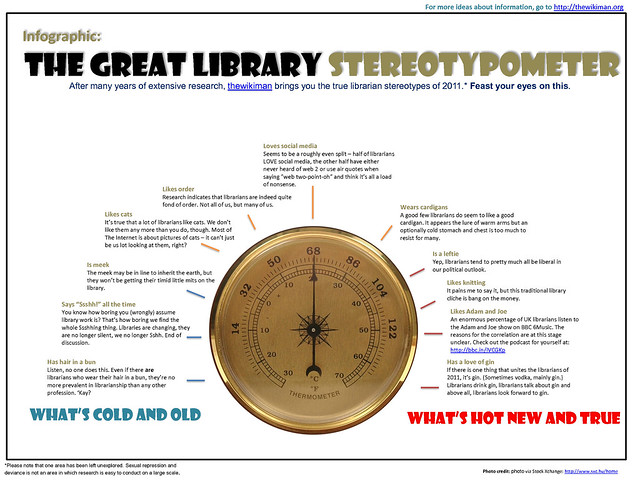
Here's a fun little 'infographic' published this week by an apologetic Wikiman:


What temperature are you? Here's how I match up:

Has hair in a bun
I've not regularly worn my hair in a bun since school, when it was temporarily fashionable so to do. The last time I bunned up was just over ten years ago when I assumed the role of an artist for a murder-mystery dinner and stored in my barnet a paint-brush and pencil. The ability to make use of the hair bun as a personal stationery-stash is of great practical value, but is offset by the comparative complexities of creating the bun when considered alongside a pony-tail or hair-gripped alternative. I would not rule out wearing a bun in future, though by current measures of fashion I would find other methods of hair-restraint to be preferable.

Says "Ssshh!" all the time
Of course, a librarian wouldn't have to say "Ssshh!" if the patrons were suitably respectful of their peers, or if the library had been built with better acoustic dampening. The Wikiman asserts that libraries "are no longer silent" anyway: terribly annoying to anybody trying to use them for study, but handy for those of us in the profession who are a touch averse to confrontation. Traditionally I fall into that latter category: certainly, this librarian...

Is meek
I don't see my meekness as a weakness, except where it verges on submissiveness and timidity and hinders my ability to confront mischief-makers. In that respect I'm very keen to find my inner harridan and unleash from her a dash of stern self-confidence. Meet one of my idols:


This is Library Ann. She is an important role-model to me, and she accompanied me throughout my library-school notes. I type the truth when I tell you that I want to be like her when I grow up. She is my image of what a librarian is and should be, and in many ways she inspired me to become one. She is generally somewhat meek, but she takes no nonsense. Though she has a schoolmarmish air, she is by no means cold, except when cold is needed. She is practical and authoritative with a cheeky sense of humour, and I admire her ability to "Ssshh!" with kindness and understanding. It is this blend of meekness and matronly sensibility that I wish to foster within myself, at least as far as my public presence is concerned. Behind the scenes I may have to be a little more wily and tenacious if I am to secure the resources that my library's patrons require. Typing of wile and tenacity...

Likes cats
I went through a phase of not liking cats, when one responded to my advances by gouging great chunks of flesh from my legs. Also, I fear the possibility that I may perhaps be allergic to their fur. I do hope that this is not the case, as, despite the brief, pain-induced aversion I experienced in my youth, I now have a great fondness for cats and aspire to share my home with at least one of their kind at some point in the future. 

Likes order
My bedroom floor suggests otherwise, but this is because my wardrobe is insufficient to my needs. In ideal circumstances I sustain a degree of order to my life and my belongings, but should circumstances slip from that ideal, so my orderliness drifts casually away: things get dumped in the sorting area of my life rather than being neatly shelved where they belong. This untidy chaos will persist until such point that it reaches a 'critical mass' whereby nothing can be successfully located within a reasonable timeframe. Only then will the order be reinstated. This, I accept, would be no way to run a library.

Loves social media
My next cpd23 post will discuss my thoughts on this matter in more detail. Previous posts have also made reference to such things. "Love" is a strong word, especially when considered against "Likes cats".

Wears cardigans
I currently own sixteen cardigans. It is not enough. 

Is a leftie
The last three times I calibrated myself against The Political Compass, my coordinates were (latest reading in bold):
Economic: -9.38, -8.88, -8.38;
Social: -7.38, -6.67, -6.41.


Likes knitting
In my early teens I used to crochet and French knit, but I've never knitted at this side of the channel. I once got a book of Vogue knitting patterns out of the library with the intention of taking it up, but I know full well that the slinky dresses therein would've come off my needles considerably baggier and less stylish than depicted. I don't think I really have the time to fit it in, either. That said, imagine all the cardigans I could make...

Likes Adam and Joe
Slack squadron Podcat. Not like some of our ilk who've been known to have the odd (non-retro) text read out. If you see me on the bus, guffawing like a loon with my earphones attached, it may not be due to some ridiculous yet risible action on your behalf but rather as a consequence of this pair's radiophonic ramblings. [Recalls BaaadDad with whimsical fondness, and sighs to the remembrance of times past].

Has a love of gin
Of all the common alcoholic beverages devised by a bored humanity, the only one for which I have no great fondness is gin. My bar is well stocked, but gin is only in there for my guests.

Totting all that up, I'd say that I come to about 25°C on The Wikiman's thermometer: neither "Cold and Old" nor "Hot New and True".

This is all good clean library fun, but there are those among us who run in horror at the scent of tweed. They worry that the apparition of a librarian in twinset and pearls is enough to make an ordinary member of the public loose their breakfast across the OPAC keyboard. In the stereotype's defence, I thought I'd end by offering a little excerpt from a recent essay what I wrote on the subject of library marketing:


“Current perceptions...may not fit the reality we wish to communicate. As the recent case of the ‘librarian doll’ offered by a US retailer shows, there is a potential for negative stereotyping. The small action figure was a bespectacled woman in a cardigan, long plain skirt and sensible shoes. An ‘amazing push button’ action moved her finger to her lips with a ‘shushing action’. Marketing can counteract such stereotypes.” (Kendrick, 2006:3)

Favourers of cardigans and plain skirts may question why this stereotype is negative (that the doll was a tribute to real librarian and campaigner Nancy Pearl lends further objection). Indeed, stereotypes lie at the heart of marketing; one should not rush to dismiss established shorthands: “In advertising you’ve probably got about thirty seconds...so the use of a stereotype is...to tell people...what the relationship is as fast as possible.” (Bullmore, 1990). If the librarian ‘brand’ is sufficiently iconic as to support a doll, might it be better to build upon that than dismiss it? “The high visibility of many librarian characters within popular culture does show good awareness levels of many positive aspects of the profession, and provides a good grounding for further sector advocacy” (Luthmann, 2007:777). One can usurp stereotypes and harness them to advantage. While we may take offence at some depictions, there exist several librarian heroes in popular fiction. Even ‘negative’ forms may not be as damaging as alleged. The irascible librarian of East Cheam is only so in the face of Tony Hancock, and the much-trod spinster cliché, like any effective stereotype, owes something to reality: most librarians are educated women, if not necessarily tweed-clad cat-lovers. Stereotypes may self-perpetuate, attracting those who conform to its model. Yet Luthmann (2007) observes a profession preoccupied with its own image, despite the wider media seeming comfortable with the stereotype. Even the born-again Frank Skinner finds parts of the image appealing. He notes with alarm the lack of books in Church Street: “I was worried that my out-of-date complaints about libraries had been replaced by a new horror — the books weren’t musty, they were missing... Angry of Hampstead, when he’s outraged at...library closures, probably doesn’t know exactly what he’s defending.” (Skinner, 2010). Any reformer must retain the baby when draining the bath.

Thanks to devocanada
Image borrowed gratefully from eBay, where you can buy the original for $10.